
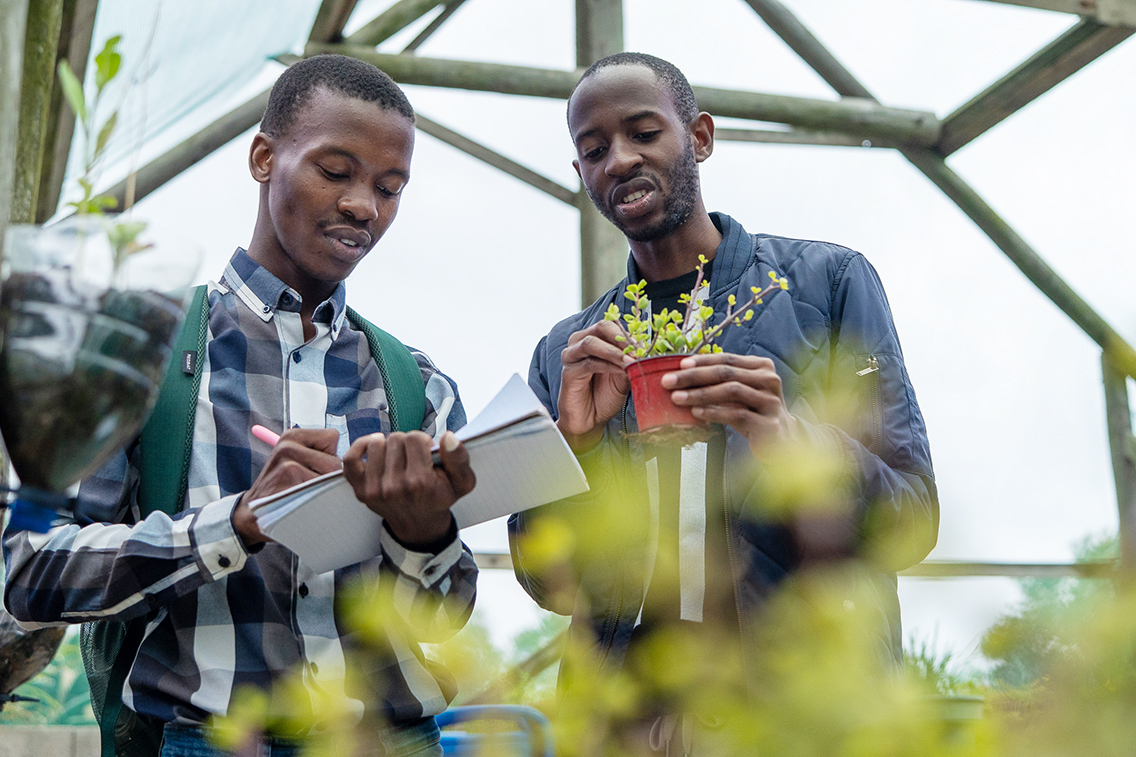
When Peter Njeri was growing up, he walked miles with his siblings in search of food. When they got home, he remembers his mother crying and choking from the fire she had made to cook. Now a student at Kenyatta University, Njeri has founded MegaGas, a startup company that converts waste into clean cooking gas. He explains: “It is very important for us to look at the problems in the community. And for us to think: how can I solve this using the local people and local resources? And then be able to build a business that can grow and become an industry, creating solutions and jobs for our people.”
Crisis becomes opportunity
The World Bank estimates that only a quarter of the 420m young people entering the formal labour market in sub-Saharan Africa find jobs. Africa’s youth is expected to double to over 830m by 2050. The Innovation for African Universities (IAU) program is the British Council’s response to this challenge.
Higher Education Institutions are pivotal in unlocking the unfulfilled potential of African youth. The IAU began in 2021 with a focus on collaboration, and sub-Saharan African universities partnered with universities in the UK. It has evolved organically, and with the launch of the Innovation and Enterprise Challenge in 2026 the focus has shifted to students. Building on the foundation previously laid, student teams in Ghana, Kenya, Nigeria and South Africa have been invited to advance solutions to priorities within their communities.
This new phase brings together two ecosystem consortia with the UK and sub-Saharan Africa, industry actors and students. The consortia are delivering tailored mentorship and capacity-building programs to 37 grantees. The industry or ecosystem partner within each enterprise consortium plays a vital role, strengthening the connection between academia and industry.
The IAU Innovation and Enterprise Challenge: impact
In Ghana, a team of students at the Kwame Nkrumah University of Science and Technology has developed an Automated Neonatal Exchange Transfusion (ANET) device. As many as 80% of pre-term babies become jaundiced in Ghana. Mothers in rural areas have no access to big hospitals, and neonatal mortality is high. With this new device, blood transfusion is safe and easy to administer. Samuel Kyei Agyemang and his research team have big aspirations: “Technology should make an impact. That is the motto that we run with. We make sure the things that we make and do have an impact on the wider society… the entire world, Africa and beyond.”
In Nigeria, a team at Awolowo University has developed a portable Compact Scanning Electron Microscope. This makes advanced high-resolution microscopy affordable and accessible. The British Council grant has enabled the students to refine and prototype their idea.
Students at the Kwame Nkrumah University of Science and Technology have used smart technology to address the public health crisis caused by illegal mining in Ghana. GalamSense, a low-cost, autonomous internet of things (IoT) network provides real-time detection of heavy metals in remote rivers. Immediate, empirical data enables authorities to pinpoint pollution sources and drive rapid intervention. This prevents birth defects and maternal deaths in vulnerable, rural communities.
The Pollen Patrollers startup, for example, has been developed by an all-woman team at Kenyatta University in Kenya. Small-scale farmers, mostly women, depend on bees for pollination of their crops. The initiative works with IoT-enabled smart hives and AI-powered precision pollination to prevent bee colony collapse and strengthen food security. They are expanding their initiative to other parts of Kenya, and plan to scale up to Tanzania and Ethiopia.
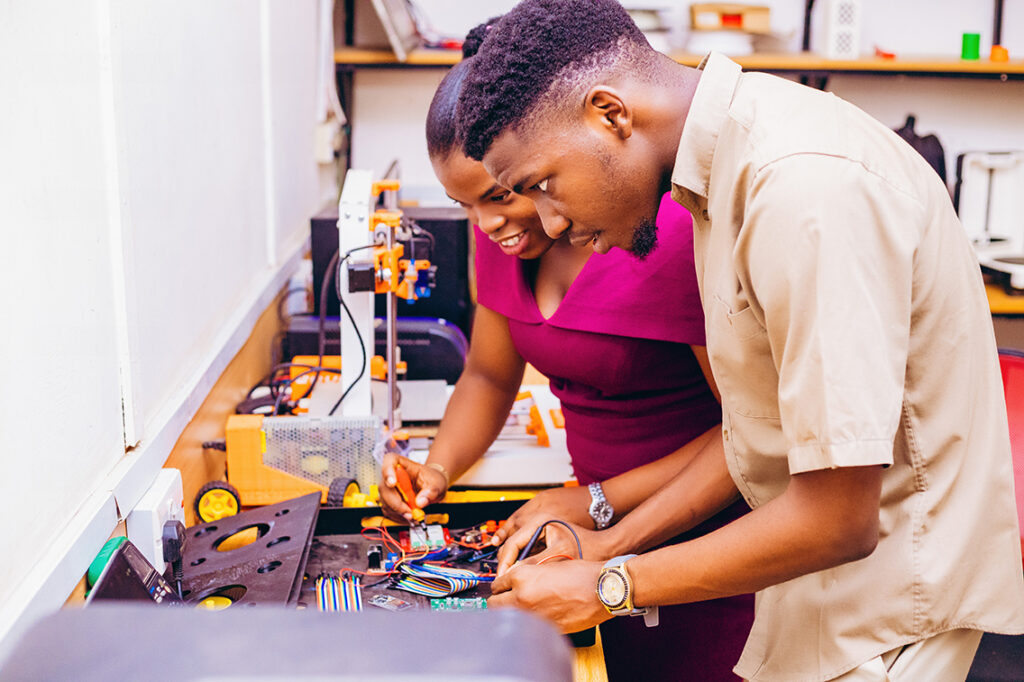
Students involved in the Batho Pele Bio-Loop Africa Farm at Nelson Mandela University in South Africa are also helping to bridge the gap between the internet, smart agriculture and rural communities. Maghawe Dube is grateful for what he has learnt from the IAU enterprise challenge: “When it comes to AI and algorithms… That’s where everything changes. Every day we are learning a new thing, so it’s excitement all the way!”
Sustainability and environmental impact are important concerns for many of the student teams. Some of their innovations have a direct impact on university life. The Electric Bicycle and Scooter Initiative provides students with affordable, eco-friendly transportation on the Akenten Appiah Menkah University campus in Ghana. EcoScriber, a paperless university admin toolkit and AI-powered skills platform at the Afe Babalola University in Nigeria, logs its environmental impacts.
The IAU is an Africa-led initiative and is relevant and responsive to local contexts. By identifying a problem and using design thinking principles and methodologies to formulate a solution, the program has avoided imposing predefined objectives and parameters. In turn, the IAU has supported UK institutions in achieving their internationalisation objectives and in establishing partnerships in sub-Saharan Africa. Some UK universities have also begun to rethink their own curricula to address the needs of diverse students, many of whom come from West Africa.
IAU Partnerships: a dynamic model
The IAU has ignited an exciting exchange of ideas and collaboration. The relationships between African and UK universities lie at the core of the program, but collaboration has also been pivotal within each enterprise challenge team itself. Students from different faculties have worked together, for example, at the University of Witwatersrand in South Africa. Lebogang Ngwatle, a development specialist at Wits, comments: “It’s very exciting to get a grant from the British Council that focuses on innovation. It really encourages students to work in teams.”
The IAU Enterprise Challenge breaks new ground in bridging the divide between academic institutions and the workplace. Professor Eric Tutu Tchao, Scientific Director at the Kwame Nkrumah University of Science and Technology in Ghana, explains: “Now you have professors whose time is focused on nurturing the entrepreneurial skills of these individuals. You have industry people collaborating on this project and giving advice on how to scale their project. I think it is brilliant!”
The IAU has forged new partnerships between African countries through curriculum collaboration. Exploring solutions to shared challenges helps to realise an important development priority of the African Union Agenda 2063.
The IAU research findings
Research studies show that the IAU program is successfully supporting the creation and survival of start-ups. However, most ventures remain in low- or pre-revenue stages.
Evidence reflects significant barriers to scaling, market access and investor connectivity. Over 90% of surveyed ventures had no structured international collaboration opportunities.
Post-incubation ecosystem support has therefore become a priority. The British Council seeks to initiate international enterprise collaboration platforms, market and investment connectivity interventions and international exposure opportunities for high-potential ventures.
Looking forward: new collaborators
The British Council places its trust in the youth, the custodians of the future. The 37 student teams selected to participate in the IAU Enterprise Challenge have proved that this is a worthwhile investment. As Chuene Semono, Project Manager at Nelson Mandela University in South Africa, remarks: “The innovations of today are the seeds of tomorrow… Everybody on this journey represents hope.”
Since the inception of the IAU, there have been 15,000 direct participants. Over 130 student-led ventures and innovations have been created or supported. There have also been 33 curricular and industry-academia partnerships, and 24 incubation or innovation hubs have been established. But the demand to deepen and scale the program is great.
The British Council is uniquely positioned to serve as a transnational broker linking universities, enterprises, investors and industry actors across African countries and the UK. They seek like-minded partners.
Meekness Lunga, Regional Director for Higher Education in Sub-Saharan Africa at the British Council, charts the way forward: “We’ve started a fire here, but we need to sustain it and keep the flame burning. We are actively seeking new partnerships to scale this and replicate our model in other countries.”