

Jeremy Awori, group chief executive officer of Ecobank, arguably the continent’s most “pan-African” financial institution, has a striking metaphor to describe the bank’s growth trajectory. “We’re trying to build a hundred-storey skyscraper,” he says. Three years into his tenure, Awori recalls the challenge he had at the outset. “I was tasked to drive up growth and to drive up returns for the shareholders.
“We focused very much around where we were not growing. We were not growing in the areas of deposits. Customer numbers weren’t moving to the trajectory that we wanted. The returns, as a result, weren’t necessarily coming through. We had a very deliberate strategy around growth, transformation and returns. We try to keep it as simple as we can keep it, but no simpler.”
And how is that 100-storey construction job progressing? The scoreboard shows that the “growth, transformation and returns” strategy is paying off, Awori argues. “Our balance sheet grew from $20bn to $25bn. Our revenue grew 17%. Our interest margins increased. We’ve seen our market cap shooting up. We’re very proud of the fact that we’ve moved from low single digits to 17% for 2025 for revenue. Now it’s actually 23% in quarter one. Of course, the income ratio moved from 53% in 2024 to 48%.”
Back to banking basics
Awori credits this to a deliberate decision to return to what he calls the “basics of banking” which, as he explains, is “how you manage your balance sheets, how you manage your pricing [and] how you manage your processes [so] you can get value coming in”.
There have also been improvements in deposits, with the bank seeing an increase of 20% in mobilisation in the last year. This has also been the result of a clear focus on improving the customer experience, reducing pain points and working with customer-facing staff to identify and resolve challenges to service delivery. An example is in the account opening process, where Awori reports that by reducing the number of forms and processes, wait time has been brought down from two days to less than two hours.
“You track, you monitor and you move quickly,” Awori says of the bank’s approach. “We are focusing on much more engagement with customers. We are increasing the number of frontline staff as a percentage of total staff, because that’s where the action is with our customers. And we’re digitising a lot of our processes, which makes them faster and more seamless, and gives you a better experience. So that’s why I think we’re seeing the results we’ve achieved,” he says.
Another group that is seeing results is the shareholders. With its improving performance, the group has been able to plough back some of the joy to shareholders, with $40m in dividends currently proposed. Investor sentiment has also strengthened and the bank’s share price on the Nigerian Stock Exchange has climbed from around 45 naira to nearly 80 naira ($0.05).
Despite this momentum, however, Awori insists the bank remains firmly in investment mode, arguing that there is still significant room for further investment as Ecobank builds for the long-term scale. It’s important, he says, for the bank to invest in building the strong foundations needed to bear the weight of the 100-storey edifice that he envisions. “We’re here for the long run,” he says. “As the continent grows and countries grow, we need to be a strong bank with firm foundations that’s well-capitalised to be able to deliver that growth.”
Growing role of technology
Technology will be key to these ambitions. Ecobank, like the rest of the sector, recognises the growing role that technology plays in banking. Globally, digital channels currently account for more than 70% of banking operations. According to industry estimates, the global banking sector is expected to spend well over $600bn annually on technology by the end of the decade, as banks race to modernise infrastructure, deploy AI tools and strengthen cybersecurity capabilities.
“Technology is fundamental to the way we do our business,” Awori confirms. “We spend a significant amount of time on our technology spend. At our last board meeting, we spent almost a day discussing our next horizon tech strategy and what we’re going to invest in, what we’re going to divest from, what we will buy versus what we will partner, what’s going into hardware versus what’s going into software.”
In 2025 alone Ecobank rolled out more than 500 new automated teller machines (ATMs) across its network, and it plans to add a similar number again this year. The bank is also investing heavily in data centres, in software development and in enterprise-wide digital architecture designed to support long-term scale across its 34-country footprint. “It’s an enterprise architecture approach,” Awori says. “We have to make it agile, adaptable, because now the rate of change is so fast that if you don’t get a return in three years, it’s obsolete.”
However, Awori is equally insistent that technology alone is not the answer. The real competitive advantage, he argues, lies in the interaction between technology and human capital. “I think talent and technology will impact processes,” he says. “With technology right now, you’ve got the ability to do things at scale at a much lower cost and much more effectively, so you can deliver even better customer experiences. But you also need your talent to be able to think through the use cases, the customer journeys and the problems you’re trying to solve.”

Intelligence, natural and artificial
Ultimately, Awori still places people at the centre of the equation. “It’s all about people. It’s not about tech,” he says. “If I had to look at it, I’d probably say 50% people, 30% tech and maybe 20% on actually getting the processes working well for staff and customers.”
Artificial intelligence is already being deployed across several areas of Ecobank’s operations with specialised systems for anti-money laundering and transaction monitoring across the group, while AI-driven models are increasingly shaping fraud detection, onboarding and credit decision-making.
Fraud monitoring has become increasingly sophisticated. And as the group pushes further into digital banking, cybersecurity will become more of an existential concern. “It’s probably the biggest risk, if we look at it right now,” Awori says. “It’s the thing which keeps us all awake at night.”
Ecobank has responded by investing aggressively in cybersecurity expertise and specialist leadership talent. “We’re putting a lot of money into training and bringing in people,” Awori says. “We’ve hired new people and senior leaders who are the best at what they do.” Here again, Awori puts his trust in humans over machines, believing that human behaviour will be more critical in warding off the threats. “It’s not so much about breakdowns in the systems. It’s about people giving away information about themselves, their banking, their PIN numbers, their passwords.”
The technological transformation underway at Ecobank has also led to broader cultural changes within the institution itself. Awori repeatedly returns to the idea that people, not technology, are the driving forces in the group. “People drive culture. Your values drive culture. Your purpose drives culture,” he says. “What are the trade-offs you’re willing to make? Where do you focus? What will we accept and what won’t we accept in terms of values? That is front and centre.”
The demographic profile of the bank is also changing. “When I came in, the average age was in the 40s,” Awori says. “Now, through turnover and bringing in new talent, that’s now in the mid-30s.” That generational change means greater agility around technology adoption. “AI literacy is so critical,” Awori says. “If you could not use Microsoft Word, you would not be accepted in the workplace. Same for AI. If you’re not AI literate, it’s going to be hard.”
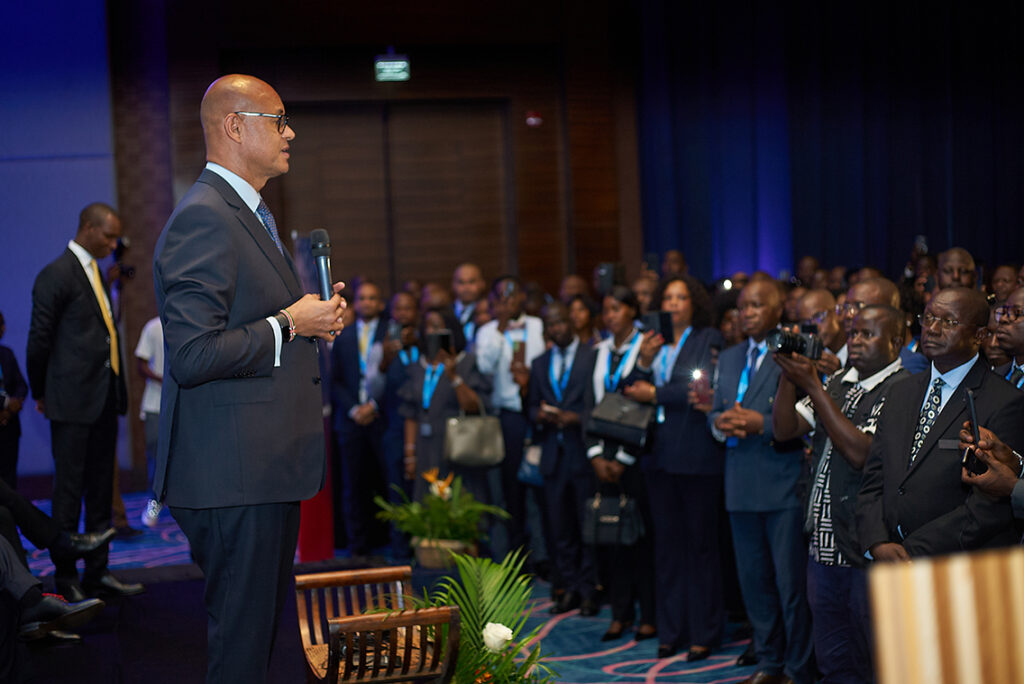
Communicating that transformation across a bank with a presence in 38 countries requires almost constant engagement from leadership. Awori says the group’s 120 senior leaders are tasked with cascading the growth, transformation and returns (GTR) strategy throughout the organisation, supported by frequent town halls, written communication and in-person meetings. “When we do our [Group] town halls, we get 4,000 or 5,000 people,” he says. “That’s where we talk about what we’re going to do, what is expected.”
Leaders must adapt
There are also shifts further upstream, including in the role of the CEO itself. Awori thinks leaders must adapt their roles to meet a moment that is shaped by rapid technological change, social media and workforces that are often geographically dispersed. “I don’t think there’s one stereotypical style anymore. People often assume that the best leaders have to be charismatic leaders, but that’s not necessarily the case. Of course, it helps if you’re charismatic because you do need to communicate, but there are many different ways of being an effective leader.”
Asked to define the institution’s culture, Awori points first to the bank’s core values and internal mantra – “brave, passionate and committed,” which manifests in the group’s activities and approaches.
“We need to be brave enough to confront the things we need to change,” Awori says. “Change is constant, and if you’re not ready to change, you’re going to struggle. We want people to bring passion to work, to do what they’re good at and what they enjoy doing, because then performance becomes much more natural.”
Beyond Ecobank itself, Awori says he remains optimistic about the broader direction of African business and finance. “What excites me is that more African institutions are now speaking the same language,” he says. “We want to solve African problems in an African way.” That cooperation, he argues, is increasingly visible between commercial banks and continental development finance institutions such as the African Export-Import Bank (Afreximbank), the African Development Bank, Africa Finance Corporation and Trade and Development Bank.
Awori believes sectors such as agriculture, manufacturing, financial inclusion and digitalisation will become major long-term growth engines if African institutions can work together more effectively.
For a bank operating across 34 African markets, the current geopolitical tensions and uncertainties require constant recalibration around risk. “Managing risk is the reality of our business,” Awori says. “The real challenge is understanding when to take more risk, when to de-risk, when to be aggressive and when to be cautious. Those are tough conversations.” That said, Awori is firm that Ecobank’s size is a source of strength. “Being present in 34 countries means we are not overly exposed to any one market.” That diversification has already been tested repeatedly in recent years. “We published record results, but at the same time we had countries within the group that were severely affected by geopolitical or macroeconomic events,” Awori says.
Ultimately, Awori argues, sustainable banking growth depends less on avoiding volatility altogether than on building institutions capable of absorbing shocks repeatedly over time. “It comes down to very considered decisions around where we put our money, how we manage risk and how disciplined we are operationally,” he says. “If you combine that with a strong technology and risk culture, then you can deliver sustainable results.”
Click here to watch the full interview.