
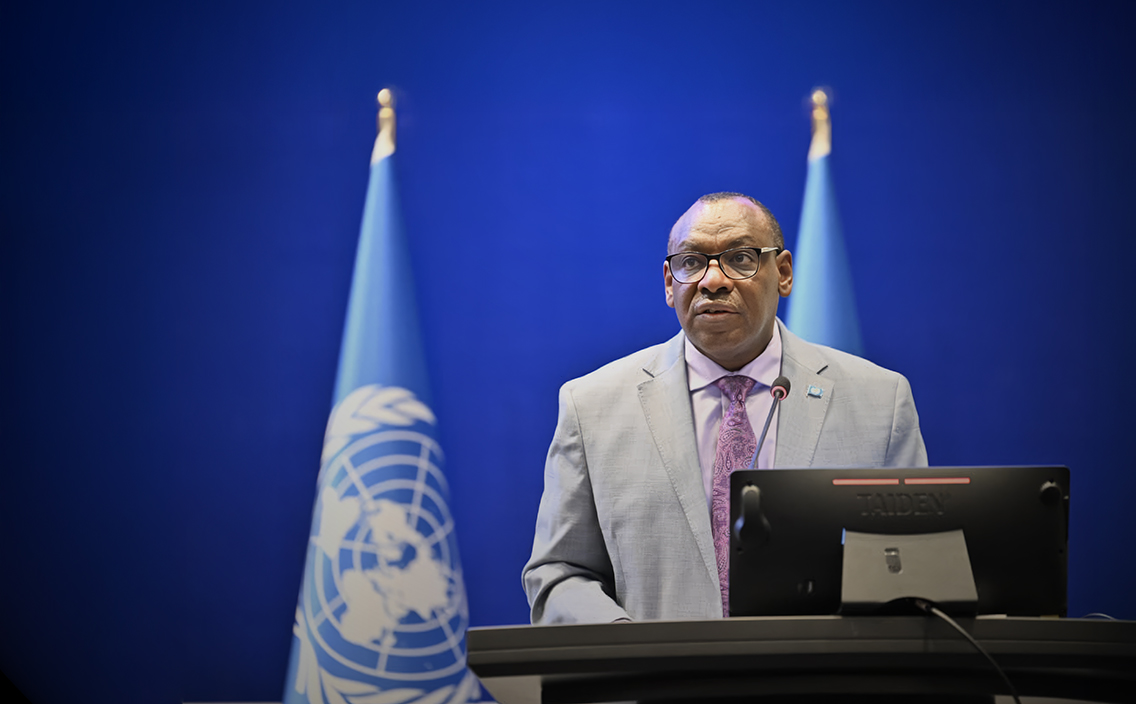
Opening the 12th Africa Regional Forum on Sustainable Development in Addis Ababa, Ethiopia, the Executive Secretary of the Economic Commission for Africa (ECA), Claver Gatete, said the continent must embrace a new phase of implementation if it is to meet the ambitions of both the 2030 Agenda and the African Union’s Agenda 2063.
“We meet at a moment of heightened global uncertainty and challenges,” Gatete said, pointing to slowing global growth, widening inequalities, rising debt vulnerabilities, intensifying climate shocks and persistent conflicts that continue to undermine stability across many parts of the continent.
Yet he cautioned that these pressures should not be seen as reasons for delay or caution. Instead, they must serve as a catalyst for innovation, deeper cooperation and renewed urgency in addressing Africa’s structural development constraints.
The Forum, convened under the theme ‘Turning the Tide: Transformative and Coordinated Actions for the 2030 Agenda and Agenda 2063′, brought together African governments, regional institutions, development partners, civil society, academia, youth representatives and the private sector.
It served as a key platform for reviewing progress and strengthening coordination on the continent’s development agenda at a critical midpoint towards the 2030 deadline for the Sustainable Development Goals.
Gatete commended Ethiopia for hosting the Forum and praised Prime Minister Abiy Ahmed’s commitment to advancing Africa’s development priorities. He also welcomed Ethiopia’s designation as host of COP32 in 2027, describing it as a significant opportunity to align climate ambition with development delivery.
He said Ethiopia offers a practical illustration of how climate action and development can reinforce each other. He highlighted the country’s Green Legacy Initiative, through which more than 40bn tree seedlings have reportedly been planted, alongside its renewable energy profile, with over 95% of electricity generated from renewable sources. He also pointed to the large-scale expansion of climate-smart agriculture across millions of hectares of rain-fed cropland.
“For Ethiopia, and for many countries represented here today, climate action and sustainable development are not competing priorities,” he said. “They are mutually reinforcing.”
A central concern of his address was the widening gap between ambition and implementation across the continent. While Africa has well-articulated frameworks in place, including the Sustainable Development Goals, Agenda 2063 and national development plans, Gatete argued that the challenge lies not in design but in execution.
“Africa’s challenge today is not a lack of frameworks,” he said. “The Sustainable Development Goals, Agenda 2063 and national development plans are well aligned. The challenge is implementation at scale.”
He stressed that the continent must now move beyond fragmented or ad hoc interventions and instead adopt systems thinking, supported by stronger coordination across sectors and institutions. This, he argued, is essential if countries are to translate policy commitments into measurable outcomes.
Africa’s productive backbone
The Forum’s thematic focus areas, including water and sanitation, sustainable cities, energy, resilient infrastructure and partnerships, were described as the productive backbone of Africa’s transformation agenda.
Gatete warned that weaknesses in these systems directly constrain growth, deepen inequality and slow progress. Conversely, when they function effectively, they can significantly enhance productivity, competitiveness and inclusion.
Against this backdrop, he outlined a set of strategic priorities that he said should guide the continent’s next phase of action. These include repositioning critical infrastructure such as water and energy systems as core economic assets rather than peripheral social services, and
addressing Africa’s significant infrastructure financing gap through innovative funding mechanisms and stronger partnerships.
He also emphasised the need to harness rapid urbanisation as an engine of growth, rather than a development challenge alone, noting that well-managed cities can become hubs of innovation, job creation and productivity.
In addition, he called for a more integrated approach to digital and green transitions, arguing that both must advance together if Africa is to remain competitive in a rapidly changing global economy.
Reliable data
Gatete further underscored the importance of anchoring delivery in reliable data, strong institutions and enhanced regional cooperation. He highlighted the African Continental Free Trade Area as a key platform for deepening value chain integration and boosting intra-African trade, which he said is essential for scaling industrialisation and economic diversification.
Cooperation, he added, will be particularly important in managing shared resources and systems such as transboundary water basins, cross-border power pools and regional infrastructure networks.
Beyond policy alignment, Gatete stressed the importance of accountability and follow-through. He paid tribute to Uganda, the outgoing Chair of the Forum’s Bureau, for its efforts in strengthening national accountability mechanisms, including public performance review processes where Ministries report directly on progress in implementing development commitments.
He also reiterated the ECA’s commitment, working with the wider United Nations system, to support member states through evidence-based policy advice, capacity building, and partnership facilitation aimed at delivering tangible results.
“This Forum is not merely a moment for reflection,” Gatete said in closing. “It is a moment for decision, to move decisively from diagnosis to delivery.”
As Africa approaches a decisive decade for global development goals, the message from Addis Ababa was clear. The continent’s ambitions are no longer in question. What remains is the capacity to implement them at scale, with urgency and coherence.