

Over the past 15 years Brand Africa has been researching and ranking the most admired brands in the continent. In that period, non-African brands have dominated the list, with an average 80% share of Africa’s most admired brands. Nike has led the rankings for the past eight years overall, and MTN and Dangote have dominated the rankings of African brands.
Behind these brands are respected and admired African marketing operations. Until now, there has not been a comprehensive record of the people behind these brands. That changes with this inaugural ACMO 100 produced by Brand Africa in partnership with African Business, MIPAD and the Africa Media Agency. Covering one hundred leaders in six African economic regions – including the diaspora – across twenty countries, more than 50 distinct role titles that span the marketing industry senior leadership, from mobile money to brewing, aviation to agribusiness, fintech to fast-moving consumer goods: This is the continent’s first definitive ranking of marketing leadership. All 100 honourees (see below) hold equal standing. The list carries no internal ranking.
Given the stature and breadth of the brands under their custodianship – and the lag in African brands – what is abundantly clear is that Africa does not have a marketing talent problem. All of leaders can eminently answer the one question: What does it take to win the African consumer?
A female-majority profession?
The most significant finding in this inaugural list is also the least surprising, at least to anyone who has spent time in African marketing. Women make up 62% of the honourees are women. While female CMOs remain underrepresented globally, in Africa they are the majority by a clear margin, across every region. The diaspora category is 75% female. East Africa reaches 72%, North Africa 71. West Africa posts exact parity. Southern Africa, the largest cohort at 39 entries, records 23 women to 16 men.
The women on this list are not emerging talent waiting for their moment: they are running marketing for South Africa’s most aggressive challenger bank, building brand strategy for pan-African telecoms groups, leading global campaigns at Netflix and Visa. The real question is not whether Africa’s marketing talent is capable of reaching the top. The question is whether it is being matched by equivalent representation at board level. The ACMO 100 results strongly suggests it is not quite there yet as the titles reflect.
Three hubs – and a rising fourth
Southern Africa leads the regional count with 39 entries. South Africa, the most industrialised nation in the continent unsurprisingly accounts for 31% of the leaders by domicile. Johannesburg functions as the marketing capital of the continent – housing regional headquarters of multinationals alongside the deepest pools of financial services, retail and fast-moving consumer goods (FMCG) talent anywhere in Africa. West Africa contributes 20, with Nigeria’s 17 entries anchoring a market of extraordinary commercial depth: from Dangote and MTN Nigeria to Interswitch and Nigerian Breweries.
East Africa’s 17 entries are anchored by Kenya at nine, shaped by the Safaricom ecosystem and the intensity of Nairobi’s competitive consumer market. But the most instructive regional story in this first edition is North Africa. Fourteen entries, with Morocco alone accounting for seven – more than Egypt and Algeria combined. Morocco’s position as a francophone-Arabic-European commercial crossroads, with Casablanca increasingly established as a hub for regional headquarters, is generating marketing talent the rest of the continent is only beginning to register.
The concentration of marketing talent mirrors the distribution of economic weight. South Africa leads the continent with a projected 2025 GDP of around $410bn, with Nigeria and Egypt close behind in the $380bn to 400bn range. Together, those three economies account for well over a third of Africa’s total output.
Kenya, at roughly $104bn, is the anchor of East Africa, while Morocco at $152bn has emerged as the commercial gateway between Africa, Europe and the Arab world, which goes some way to explaining why the ACMO 100’s three dominant domiciles are Johannesburg, Lagos and Nairobi, and why Morocco’s seven entries outpace Egypt and Algeria.
Eight diaspora leaders, based in the USA and United Arab Emirates (UAE), running marketing at Visa, Unilever, Doordash and BET Media Group, underscore the mobility of African-origin talent operating at the very top of the world’s most competitive brand portfolios that are staple for African consumers.
Banks, breweries and the new battlegrounds
Africa’s largest marketing investments have always flowed through its banks, mobile networks and beverage companies and the ACMO 100 reflects that trend. Financial services lead with over 30 entries, reflecting the scale of the continent’s financial inclusion wave and the premium that brand trust commands in markets where millions are transacting formally for the first time. This category is followed by Alcoholic beverages and telecommunications in an intriguing order worth dwelling on.
Breweries – AB InBev, Diageo, Heineken, Nigerian Breweries – operate under strict regulatory environments across African markets. While they cannot advertise freely, nor rely on digital targeting in the way that a fintech can, they consistently produce some of Africa’s most creative and culturally resonant campaigns. The marketers who have built careers under those constraints tend to be among the most technically accomplished on the continent.
Technology at four is a category on the rise. African fintech, edtech and e-commerce are producing a generation of growth marketers who will define what African brand-building looks like in the next decade.
The CMO by any other name
Fewer than half the leaders on this list carry the title CMO. The rest operate under more than 50 different designations – Chief Commercial Officer, Chief Growth Officer, Chief Consumer Officer, Director of Marketing and Communications, Managing Executive: Brand Marketing, Group Vice President Corporate Communications. In putting together the ACMO 100, nomenclature was not the criteria – but rather the function, scope and role in the decision making of the various organisations.
The ACMO 100 selection criteria are built around strategic ownership of brand, consumer insight, revenue growth and market positioning rather than job title. That matters most in financial services and telecoms, where regulatory environments make communications inseparable from brand management, and where the most senior marketing executives frequently carry portfolio titles that obscure the scale of their accountability.
For example, François Viviers at Capitec Bank is Group Executive for Marketing and Communications, overseeing brand strategy for one of South Africa’s most remarkable challenger stories; Andisa Ntsubane at Vodacom holds a pan-continental mandate as Managing Executive: Brand Marketing and Communications Africa; Mounir Jazouli is the Chief Marketing and Institutional Relations Officer at Bank of Africa; and Anthony Chiejina at Dangote Group is Chief Group Brand and Comms Officer for a conglomerate with operations across 36 African countries.
These are not only communications functions. They are the overall marketing leadership of organisations that shape how millions of Africans relate to the products and services that define daily life.
The bigger picture
The ACMO 100 does not exist apart from the broader Brand Africa story. For more than a decade, the Brand Africa 100: Africa’s Best Brands survey has tracked what Africans most admire – covering over 30 countries, generating 180,000 brand mentions annually. The finding has been consistent and sobering: non-African brands hold an average 80% share. African brands peaked at 34% in 2011 and have fallen to a historic low of 11% in 2025. Only five African brands have appeared in every edition since the survey began: Dangote, Glo, MTN, Tiger Brands and Tusker.
Those five are a product of sustained, disciplined, culturally intelligent marketing investment by leaders of exactly the calibre this ranking celebrates. The sectors in which African brands are strongest – financial services, beverages, telecoms, consumer goods – are the same sectors where the deepest marketing talent has been cultivated. They feed each other.
Thirty-nine of the 100 work at global multinationals. Their inclusion makes sense as the ACMO 100 recognises marketing excellence wherever it operates, including in service of global brands in and through to African markets. But the more consequential question is what the 42 leaders at Africa-reach brands – MTN, ABSA, Standard Bank, KCB, Interswitch, Dangote – will do with the next decade. Those are the people with the clearest opportunity to shift the narrative and trajectory of African brands.
Baobab award
The baobab does not rush to prove its worth – it stands, endures and shapes the landscape around it. So it is with the leaders honoured by this inaugural brand leadership Hall of Fame. This is not a recognition of a moment, but a tribute to an impactful career. These are African and diaspora icons whose work has defined, elevated, and expanded the possibilities of African-led brand leadership. They have not simply succeeded – they have set the benchmark. The Baobab Award honours not just their achievements, but their enduring legacy of exceptional brand leadership.
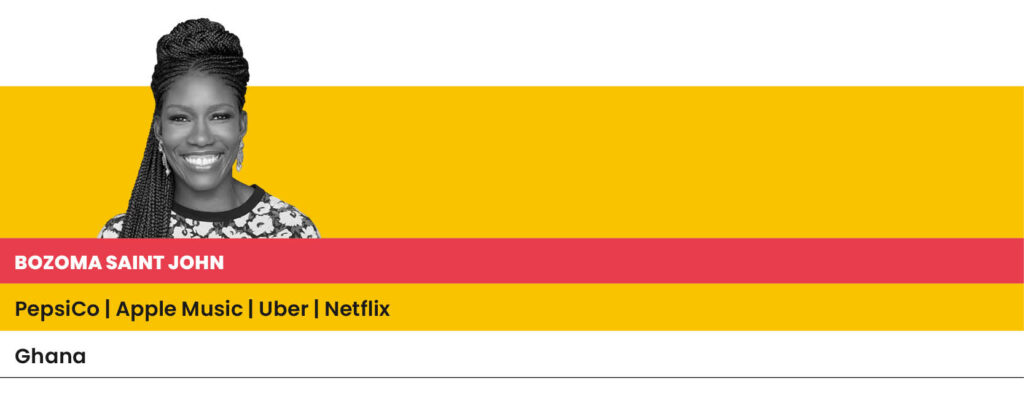
The list of brands that Bozoma Saint John has led reads like a masterclass in cultural marketing. PepsiCo. Apple Music and iTunes, where she took the stage at the 2016 Worldwide Developers Conference in one of the most-discussed moments in that event’s history. Uber, as Chief Brand Officer. Netflix, as Global CMO and the company’s first ever black C-level executive. Forbes named her the world’s most influential CMO. Harvard Business School published a case study on her career. She is in the American Marketing Association Marketing Hall of Fame. Saint John is Ghanaian. Her memoir, The Urgent Life, and her haircare brand Eve by Boz – built on indigenous African ingredients, made in Ghana – are the same conviction expressed in different forms.
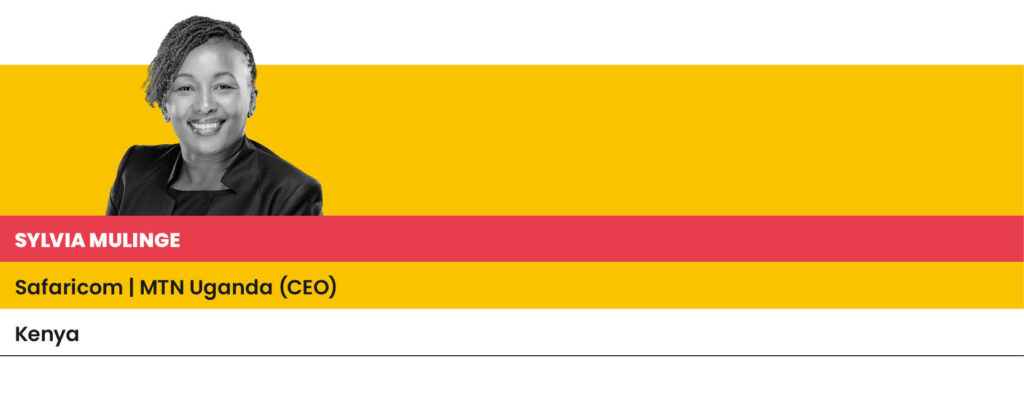
Sylvia Mulinge spent more than 15 years at Safaricom, rising from Prepay Product Manager to Chief Consumer Business Officer. In October 2022, she became the first-ever female CEO of MTN Uganda. Net profit grew 30% to 641.5bn Ugandan shillings ($170m) in 2024; revenue rose nearly 19%. In February 2025, she was named CEO of the Year across all 20 MTN markets. Her career makes the clearest possible statement about what happens when marketing and commercial disciplines are understood as inseparable.
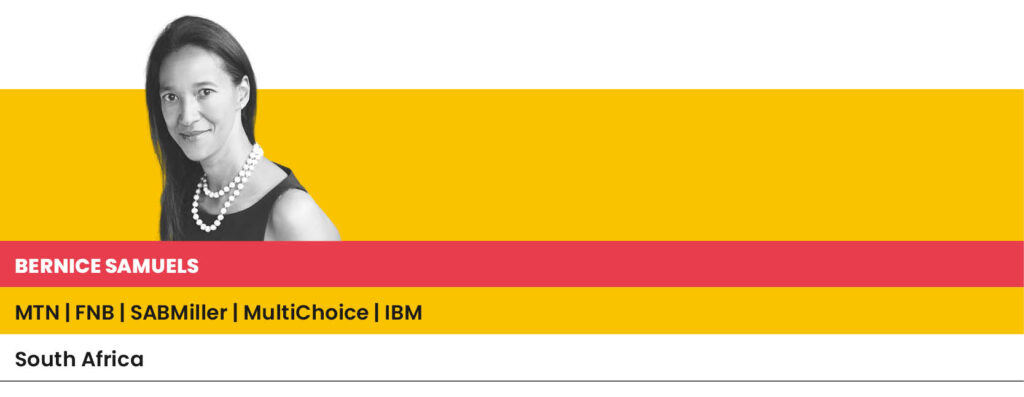
When Bernice Samuels retires from MTN in 2026 after more than three decades, she will leave behind one of the most decorated marketing legacies on the continent. Her career has crossed telecoms, brewing, financial services, broadcasting and technology – shaping brand strategy across 23 markets. As MTN Group Executive for Brand and Marketing since 2017, and in earlier roles as CMO of MTN South Africa and CMO of FNB, she drove brand positioning anchored in the conviction that “a brand is as a brand does.” She was named Marketer of the Year in both 2012 and 2021 and recieved the Financial Mail Adfocus Lifetime Achiever Award in 2020.
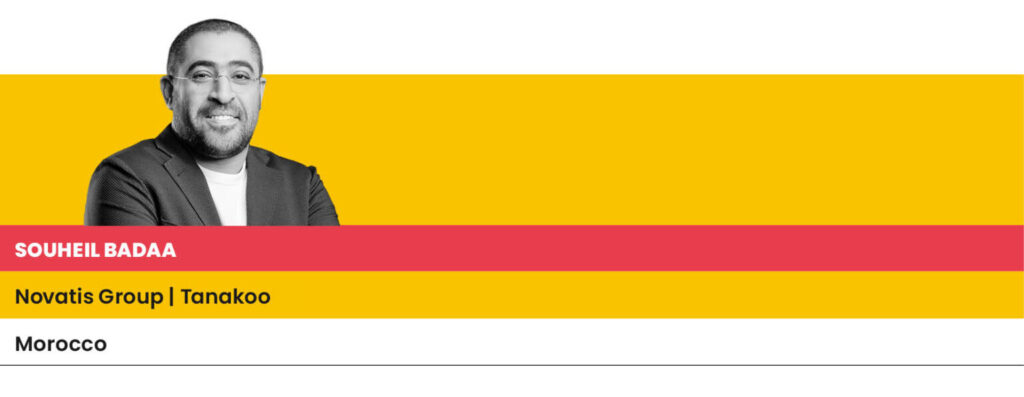
Souheil Badaa built his credentials in the FMCG and consumer goods markets of North Africa and the Gulf before founding Tanakoo, a Moroccan chocolate and snacking manufacturer that has become one of the continent’s most admired consumer brands in its category. His inclusion reflects a truth about what marketing leadership ultimately becomes at the highest level: the best practitioners eventually outgrow the CMO title, becoming founders and entrepreneurs who express their marketing philosophy through the entire architecture of a business. Tanakoo is not built for Morocco. It is built for Africa.
This article was produced by Brand Africa in partnership with African Business, MIPAD and the Africa Media Agency.