
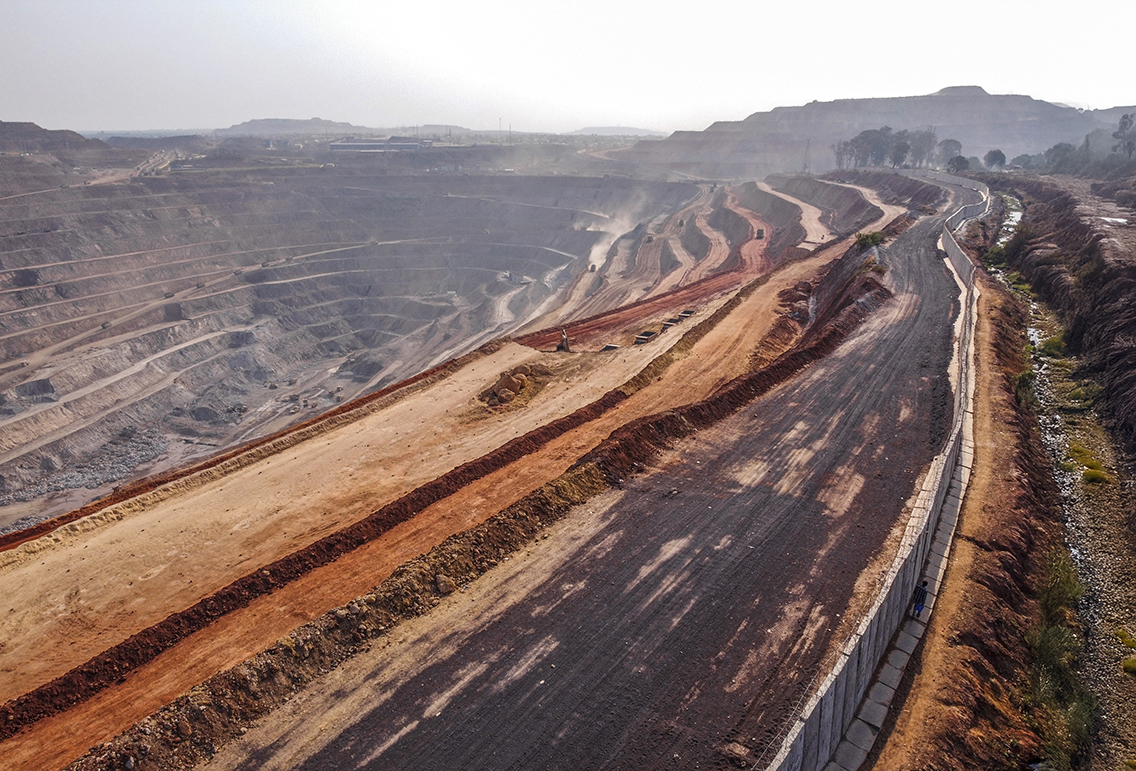
The Democratic Republic of Congo’s economic potential remains largely unexploited. The mining sector is the centrepiece of the national economy, with the US State Department estimating the value of its mineral resources at $25 trillion in 2023. Yet it also possesses huge hydroelectric potential, a rapidly growing population and the world’s second-biggest rainforest with potential for valuable carbon credits. Once its strategic location at the heart of Africa is thrown into the mix, the country’s economic attraction is clear; but it has barely begun to turn that potential into value.
After decades of conflict and instability, the economy has grown since the Covid-19 pandemic, averaging 7.25% annual growth over the four years from 2021 to 2024. Mining sector growth of 12.8% in 2024, mainly from higher cobalt and copper production, helped drive 6.5% growth in the economy, while the World Bank predicted 5.1% growth in 2025.
Long-term trends suggest that the country could become more important to African economic development. Its unique position at the centre of Africa means that it is well placed to facilitate international trade, particularly through the implementation of the African Continental Free Trade Area (AfCFTA).
The DRC’s demographic growth has made it a huge market for consumer goods and other products. The population grew from 26m in 1980 to 114m in 2025, with the UN forecasting a rise to 379m by 2100, which would make it the fifth most populous country in the world.
Critical minerals
The country is home to rare and critical minerals such as coltan, which is essential to many electronic devices; and cobalt, required for lithium-ion batteries. Copper, lithium, manganese and other critical minerals are crucial to the energy transition. The southeast provinces of Haut-Katanga and Lualaba provide more than 70% of the world’s cobalt supplies, while the provinces most affected by the current fighting, North Kivu, South Kivu and Ituri, are rich in tin, tantalum, tungsten and gold; but armed conflict deters investment.
Foreign companies, mainly from China, currently control most mining assets. An interesting economic clause in the December agreement between the governments of Rwanda and the DRC specifies that the two governments are to work to “expand foreign trade and investment” in critical mineral supply chains, although Kinshasa denied that it had offered the US a “peace for minerals” deal.
Critical minerals are becoming increasingly important to the global economy, particularly in the solar, wind, electric vehicle and mobile telecoms sectors. Chinese companies currently dominate global critical mineral production and processing. The US and other Western governments had previously been content to allow market forces determine supply but Washington now views critical minerals as a matter of national security.
First President Joe Biden’s Inflation Reduction Act and now President Trump’s “One Big Beautiful Bill” offer tax credits, financing and offtake guarantees for critical mineral supply chains.
European governments have intervened in the market less robustly, but the EU adopted its RESourceEU action plan in December to speed up critical minerals permitting and financing in support of its 2024 Critical Raw Materials Act. All these initiatives are likely to trigger greater investment in Congolese projects by US and European companies.
Congo rainforest
One of the country’s biggest natural resources currently generates relatively little income. The Congo rainforest covers about 145m hectares, two-thirds of the country. There is some logging, but much more income could be generated by tying forest preservation with carbon credits, given that the country’s forests store about 85bn tons of carbon dioxide.
But money is trickling in. In June 2025 Kinshasa received its first payment of $19.47m from the World Bank’s Forest Carbon Partnership Facility for reducing 3.89m tons of carbon emissions by protecting forests in Mai-Ndombe Province. While this is encouraging, the government has to make clear that the DRC is not waiting for handouts: it is offering a partnership. The country is ready to protect its forests and accelerate adaptation if the world finally agrees to pay the fair price for this protection. The DRC is ready to build a decarbonised and inclusive economy, if promises are turned into disbursements and technology transfers.
Nothing illustrates the DRC’s commitments like the creation of the Kivu-Kinshasa Green Corridor, the world’s largest community-based protected area, covering approximately 540,000 square km. The ambition is to protect 100,000 square km of primary forests and to create jobs and income by replacing war economies with legal and sustainable activities.
On the international stage, the DRC is working with Brazil and Indonesia to consolidate an alliance of the three major tropical basins through the Brazilian initiative Tropical Forests Forever Facility (TFFF), whose logic- sustainable, performance-based, and transparently disbursed payments – aligns with assigning real value to ecosystem services and directing benefits to the primary guardians of the forest, namely indigenous peoples, local communities, and protected area managers.
Improving infrastructure
Improving national infrastructure is the key to lifting the country’s long-term growth prospects. In 2025 8,000 km of agricultural access roads were maintained and the government committed to rehabilitating 38,000 km of agricultural access roads and 11,423 km of additional priority roads over one year.
The government has banked on mining asset-for-infrastructure deals with Chinese companies to finance new infrastructure projects, but these have largely failed to pay off in terms of actual project development. The government’s resources are limited, especially with a tax-to-GDP ratio of 12.5% in 2022, lower than the sub-Saharan average of 16%. International financing will therefore be crucial.
Current total installed generating capacity in the DRC stands at about 3,200 MW, almost all of it from the hydro sector. But the potential for more is huge because the country possesses the biggest hydroelectric potential in Africa, estimated at about 100,000 MW, mostly at the Inga site in the far west of the country, about 225 km downstream of Kinshasa.
Much of the power generated is consumed by the mining sector even though many mines have their own diesel generators or larger power plants. Two projects were developed at Inga in the 1970s and 1980s: Inga I with 351 MW and Inga II with 1,424 MW; but both operate below their nameplate capacities.
The Inga III site would be much bigger, offering about 4,800 MW, while Grand Inga could be as big as 40,000 MW spread over eight dams, much bigger than the world’s current biggest hydro scheme, the 22,500 MW Three Gorges Dam in China. However, the current project price tag stands at $80bn to $100bn, including the construction of cross-continental transmission lines, making Grand Inga a massive gamble in both economic and security terms.
Talks on financing are ongoing but have made little headway, although the Inga Development Agency now highlights the project’s ability to supply data centres.
The growing popularity of AI and cloud computing is leading huge investment in new data centres worldwide, with some now planned for Ethiopia that would be powered by relatively cheap hydroelectricity. Replicating this model in the DRC could help finance Inga III or even Grand Inga but there is a long way to go before either project can become a reality.
The country’s equatorial location and huge land area give it massive solar irradiation, but it had just 25 MW installed solar capacity in 2022. Nevertheless, falling solar module costs and increased efficiency mean that the rollout of residential, commercial and utility-scale projects is likely to increase. The sector is also far easier to scale up than hydro or thermal power production.
Lobito Corridor
Transport infrastructure remains fragmented and it remains difficult to move around the country by road.
The desire to secure access to Congolese minerals has already triggered new investment in the Lobito Corridor to ease the transport of commodities by rail from Congolese and Zambian mines to the Angolan port of Lobito on the Atlantic coast for shipment to North America and Western Europe. But the Lobito Corridor is much more than this and has been designed to help the structural transformation of the country with many economic advantages.
The lack of transport infrastructure made it difficult to build agricultural supply chains, preventing farmers from moving goods to market. The Corridor will help overcome such constraints. The country’s vast territory means there is plenty of room for agriculture in what are often very fertile soils. Crop cultivation, including of cassava and maize, could be hugely increased, with value chain opportunities in processing, driving economic diversification outside of the mining sector.
Multilateralism as an imperative
The DRC has been sitting on the UN Security Council as a non-permanent member for the (2026–2027) period since January 1, 2026. The country views multilateralism no longer as an option, but an essential requirement.
Speaking at the 80th UN General Assembly, President Félix Antoine Tshisekedi Tshilombo of the DRC underlined this imperative: “the profound changes of our time, including persistent armed conflict, climate change, recurring humanitarian crises and multifaceted transnational threats, remind us that multilateralism is no longer an option, but an unavoidable requirement that we must meet. We remain convinced that the answers to the challenges of the 21st century can only come from collective solutions based on cooperation, justice and shared responsibility.”
The DRC’s participation as a non-permanent member of the Security Council for the period 2026–2027 will focus on two inseparable priorities: peace and security on the one hand, and conflict prevention and resolution on the other.
DRC will also advocate for a more prominent role for Africa, seeking two additional seats in the non-permanent category and two in the permanent category.
The presidency has made it clear that despite recent setbacks, it will continue the momentum of African peace initiatives in the situation in eastern DRC. This requires the African Union organs to reaffirm their commitment to the fundamental principles in order to consolidate a harmonised framework for action to restore lasting peace in eastern Democratic Republic of Congo.